

Beyond the 3-3-3 Rule: Why Rescue Dogs Need Time, Not a Timeline
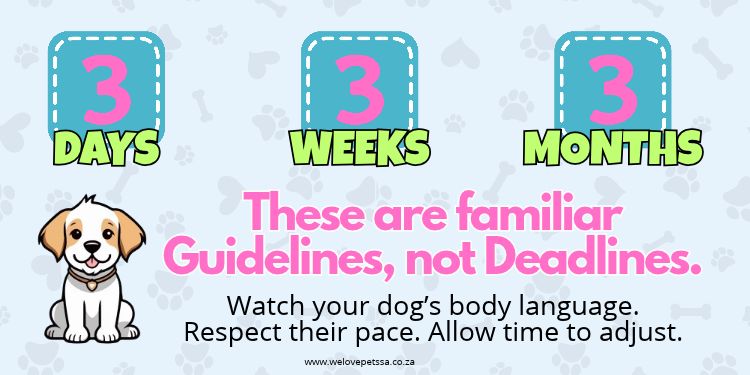
The 3-3-3 rule suggests that newly adopted dogs need three days to decompress, three weeks to adjust to their new routine and three months to feel at home. While this can be a helpful reminder to be patient, there is no established scientific evidence supporting these exact timelines for every dog. Genetics, health, previous experiences and environment all influence how a dog responds to change. Some dogs settle relatively quickly, while others may need considerably longer.
What is the 3-3-3 rule for rescue dogs?
You’ve probably all seen the 3-3-3 rule posts on social media regarding the settling-in period for a rescue dog. The posts describe how a new rescue dog may be feeling in the early days after they arrive home. This concept is thought to have started years ago within the rescue community, as a way of helping people understand their newly adopted dog and giving them time to settle into their new environment. Like many guidelines when it comes to dogs, this information has been passed from person to person, with little evidence to support these timelines.
Is the 3-3-3 rule scientifically proven?
There is no actual scientific research that supports the 3-day, 3-week and 3-month rule. Much of the evidence is anecdotal, coming from people who have worked with rescue dogs. While it may not be accurate, it is a helpful idea that shows people just how important it is to give a newly adopted dog time to settle.
Three days to decompress, three weeks to learn your routine and three months to feel secure and bond with the family. For many of us who have welcomed a rescue into our homes, these infographics make sense. We welcomed an overwhelmed, unfamiliar dog into our home and, a few months later, they feel like a valued member of the family and we can’t imagine life without them. However, for some, this is not their experience and before sharing these expectations, we should look at what research actually tells us is true and how much is anecdotal.

What does decompression mean for a rescue dog?
Decompression is stress recovery. It is a period of time where we allow a dog to calm down after a stressful event, such as leaving the chaotic environment of a shelter. We create a calm environment and minimise stress as much as possible to allow them to recover, so things, such as cortisol levels that were elevated, have a chance to return to normal.
When a dog’s cortisol levels are high, it is well researched that this can have an impact on their ability to learn. Allowing a dog to decompress when they arrive in our home reduces the expectation we put on them to fit in straight away. The three days to decompress rule comes from an idea within the dog training community that it takes around 24–72 hours for a dog to decompress and that, after experiencing a stressful event, we should give them a 72-hour ‘cortisol holiday’.
Why do some rescue dogs take longer to settle?
However, stress response and recovery are far more complex than this and, like with everything, the individual dog matters. Genetics, environment, learned behaviour, health and past experiences can all contribute to how a dog responds to and recovers from a stressful event. There are some confident dogs where a stressful event may cause them to startle, but they recover quickly. Others may not have the tools to process sudden changes and may need a calm environment for much longer than three days.
Can an adopted dog's behaviour change over several months?
This is where fixed timelines become difficult. According to the 3-3-3 posts, three weeks is when our newly adopted dog should have learned our routine, begun to trust us and started building confidence. Some infographics say this is when behavioural issues should disappear, while others say this is when behavioural problems may begin to surface. The three-month mark is then supposed to be when a dog feels completely comfortable and has a sense of security with their new family.
Again, this will be different for each dog. A dog that has had little or negative experience with people will likely take longer to feel secure in their new home, while a dog that has had positive experiences with people may bond much faster. A study by Bohland et al. in 2023 looked at changes in behaviour after adoption in shelter dogs and found that behavioural change was dynamic and could potentially continue for months. Some behaviours decreased while others increased, and these changes could also be influenced by new experiences.
Why a new home can still feel overwhelming
In South Africa, many of our shelter dogs come from disadvantaged areas where there may have been neglect, a lack of veterinary care and limited access to basic resources. Moving from a poverty-stricken area to a spacious home in the suburbs may, on paper, seem like an extremely positive change. However, for the dog, it is still a completely different environment, with very little that resembles what they previously called home. Adapting to such a major change may take considerably longer than three weeks or even three months.
Published data from South African shelters is limited, but evidence from other parts of the world shows that early returns are a real issue for shelters. A 2022 study looking at RSPCA Queensland found that, out of 6,212 dog adoptions, 865 dogs were returned to the shelter. Of those returns, 64% happened within the first 14 days, and 119 dogs were returned on the same day they were adopted.
Many returns happen because the dog that arrives home does not match what the adopter expected. This is where a revised 3-3-3 rule may still have value. Even if the timeframes themselves are not scientifically accurate, the message behind them reminds people that a newly adopted dog may need time to adjust and that what they see in the first few days may not be what that dog is like once they have settled.
Beyond the timeline: Get to know the dog in front of you
Rather than suggesting that every dog needs three days of decompression, three weeks of learning a routine and three months to bond, pet parents can learn educated on topics such as canine body language and how to recognise whether their particular dog is feeling relaxed or stressed. Also, what decompression looks like in the home and how best to prepare the your home in preparation for the new arrival. This allows them to move at that dog’s pace and plan introductions and new experiences accordingly. Allowing a period of decompression, determined by that particular dog, where expectations are low, there is little pressure and the dog has plenty of choice, is important. What is important is recognising that not all dogs fit the same mould.
DISCLAIMER:This article is for general educational purposes and is not a substitute for individualised advice from a qualified veterinarian or accredited animal behaviourist. If your dog shows signs of fear, anxiety or shutdown, please consult a vet or qualified behaviourist for a tailored plan.


At Oday Vets, we’re more than just a specialist veterinary clinic, we’re a family-run business in Centurion, Gauteng, passionate about providing exceptional, personalised care for every animal we meet. Our team is led by a veterinary ophthalmologist, and a vet nurse, and certified animal behaviourist, working together to ensure your pet receives expert medical care, behavioural support and products we’d use with our own pets. Whether you’re based in Centurion, across Gauteng, or further afield, your pet’s wellbeing is our family’s mission.