
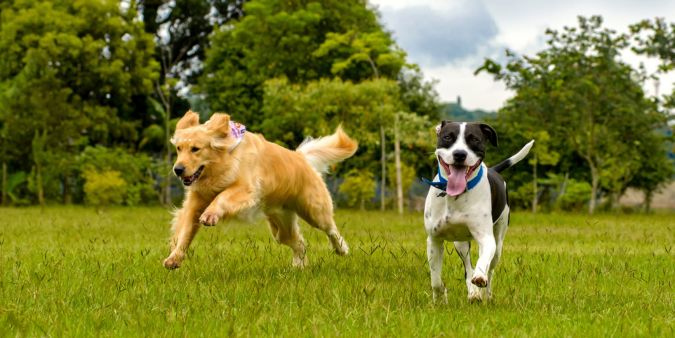
“Don’t Worry, He’s Friendly!” What to Do When an Off-Leash Dog Approaches Yours
If an unfamiliar off-leash dog approaches, assess the situation, create distance early and use available barriers where possible. Ask its owner clearly to call the dog away. Avoid assuming a greeting is safe simply because the owner says the dog is friendly.
There are few phrases more frustrating to hear when you’re holding onto your dog’s lead and watching an unfamiliar dog charge towards you: “Don’t worry! He’s friendly!” Perhaps he is. But that isn’t really the point. Your dog may not be friendly. Your dog may be frightened. She may be recovering from surgery. He may be elderly, sore or partially blind. She may be a rescue dog learning that the world is safe. He may be in training. She may simply dislike strange dogs rushing into her personal space. Or perhaps you, the human holding the lead, simply don’t want your dog interacting with another dog. That should be enough. Responsible dog ownership isn’t only about knowing your own dog. It’s also about respecting everybody else’s.
Why the lead matters
There are dozens of reasons someone might choose to walk a dog on-lead. The dog could be reactive, nervous or easily overwhelmed. It could have a high prey drive. It could be undergoing behavioural rehabilitation. It could be injured or recovering from an operation. It could be a working or sporting dog whose owner is training. A puppy might be learning how to ignore other dogs rather than greeting every animal it sees. And sometimes there is absolutely nothing “wrong” with the dog at all. Its owner simply doesn’t want it greeting unfamiliar dogs.
A lead therefore doesn’t mean: “My dog would desperately like to meet your dog but unfortunately I am restraining it.” Sometimes it means exactly the opposite. Please give us space.
The problem with “Mine is friendly”
Imagine being strapped into a seat while a stranger runs towards you shouting, hugging and getting into your face. Someone standing twenty metres away calls: “IT’S FINE! HE LOVES PEOPLE!”
Why an off-leash approach can be unfair
There is another problem.
An off-leash dog has freedom of movement. A leashed dog doesn’t. The loose dog can approach, retreat, circle, sniff, run away and change direction. The leashed dog has a limited radius around its handler. That imbalance can make an already uncomfortable interaction much more difficult. And if the person with the leashed dog tries to move away while the loose dog keeps following, the situation can escalate very quickly.
This is why “friendly” isn’t the standard we should be aiming for. Under control is. A truly well-managed offleash dog shouldn’t need every other dog it sees to be friendly, because it shouldn’t be running up to them without permission in the first place.
What does the law say?
Dog-control rules differ between South African municipalities, so owners should check the by-laws where they live. But many municipalities require dogs to be leashed in public spaces unless they are in an area specifically designated for off-leash or free-running dogs. The principle behind these rules is simple: public spaces are shared spaces. Dog lovers share them with people who are frightened of dogs, children, runners, cyclists, wildlife, elderly people and other dog owners. And even in a designated off-leash area, “offleash” shouldn’t mean “out of control”. If your dog cannot reliably be recalled from another dog, person or distraction, you need to seriously consider whether it should be loose in that environment.
So what do you actually do when a loose dog approaches?
We can talk about responsible ownership until we’re blue in the face, but we also live in the real world. At some point, most dog owners are going to encounter an off-leash dog whose owner is fifty metres away enthusiastically shouting a name the dog is completely ignoring.
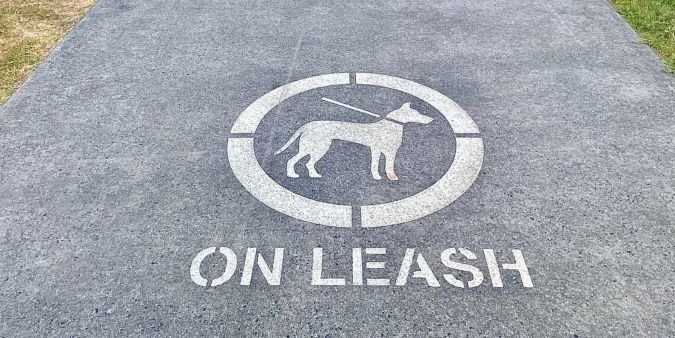
So have a plan
1. Try not to panic
This is easier said than done, particularly if your dog has previously been attacked. But immediately screaming, running or wildly pulling your dog away can increase excitement and tension.
Assess what you’re looking at. Is the approaching dog loose and wiggly? Stiff and staring? Charging directly towards you? Curving around? Barking? Hackles raised? You don’t need to diagnose the dog’s intentions. You simply need enough information to decide whether you can calmly create distance or whether you need to act quickly.
2. Create distance early
Don’t wait until the strange dog is nose-tonose with yours. If you spot it early enough, change direction. Cross the road. Move behind a gate, fence, parked vehicle or other physical barrier. Distance is one of the simplest tools you have. And there is absolutely no prize for standing your ground because your dog “should be able to cope”. If you can avoid the interaction, avoid it.
3. Put yourself between the dogs
If the dog continues approaching, position your body between the unfamiliar dog and yours. Keep your own dog behind you as much as possible. You are effectively telling your dog: I’ve got this. You don’t have to deal with it.
You can extend an arm towards the approaching dog with your palm facing it and use a firm voice: “NO.” “STOP.” “GO HOME.” You don’t need to scream hysterically. Think firm, confident and boring. Some dogs will hesitate simply because a human has clearly blocked their approach.
4. Tell the owner exactly what you need
This isn’t the moment for a lengthy discussion about canine behaviour. Keep it simple. “Please call your dog.” If you hear the inevitable: “But he’s friendly!” You can answer: “Mine needs space. Please call your dog.” If they continue: “I don’t want them to meet. Please get your dog.”
Notice that none of these statements requires you to explain yourself. You don’t owe a stranger your dog’s medical or behavioural history before they respect your request. “My dog needs space” is enough.
5. Don’t automatically tighten the lead as far as possible
Your instinct may be to haul your dog tightly against your legs. Sometimes you will have no choice, particularly when you’re trying to move away. But where circumstances allow, avoid creating unnecessary constant tension on the lead. A very tight lead can restrict your dog’s movement and add frustration or pressure to an already uncomfortable situation. The goal is control without turning the lead into a tow rope.
6. Use barriers
Your body is one barrier, but use your surroundings too. A bench, tree, bin, car, fence or gate can give you precious space. Even moving around a parked vehicle can interrupt a dog’s direct approach long enough for its owner to catch up.
7. Consider carrying a non-contact deterrent
Some walkers carry an umbrella that can be opened to create a visual barrier, while others carry pet-safe deterrent products or make use of a loud noise to interrupt an approaching dog. The goal should be to stop the approach without injuring the animal. Some people carry electronic self-defence devices because the crackling sound can startle an approaching dog. But you may not deliberately shock an animal, it’s only for the noise to de-escalate an encounter. A barrier or humane, non-contact deterrent is preferable whenever possible.
Whatever you carry, learn how to use it before you need it. An emergency is a terrible time to discover you can’t open your umbrella.
8. Treats can sometimes buy you time
If the approaching dog appears nonaggressive and is simply overenthusiastic, throwing a handful of treats away from you can occasionally interrupt its approach while you move your dog in the opposite direction.
There are situations where this isn’t appropriate, particularly where food could increase conflict. So it isn’t a universal solution. Think of it as one possible tool rather than the solution.
9. Don’t pick your dog up automatically
If you have a small dog, your instinct may be to scoop it into your arms. Sometimes that may be necessary for immediate safety. But be careful. An excited dog may jump up after it and you could end up putting yourself in the middle of the encounter. Where possible, prioritise creating distance and putting a barrier between the dogs.
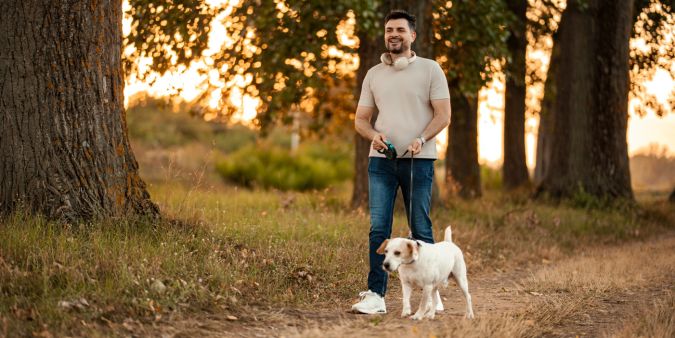
What if your dog is reactive?
This is where loose dogs can be particularly unfair. A reactive dog and its owner may have spent months working carefully on increasing distance, rewarding calm behaviour and teaching the dog that seeing another dog doesn’t mean disaster. One uncontrolled encounter can be an enormous setback. And here’s the important part: A reactive dog isn’t a bad dog. Reactivity can come from fear, frustration, previous experiences, over-arousal or many other causes. If you see someone deliberately moving away from you with their dog, don’t follow them because your dog “just wants to say hello”.
They’re communicating with you. Listen.
But my dog genuinely IS friendly. Fantastic. Then teach it to leave other dogs alone. One of the most useful skills a sociable dog can learn is that it doesn’t get to greet everyone.
If your dog genuinely is friendly
Your dog should ideally be able to see another dog, remain with you and move on. If you’re somewhere that legally permits offleash exercise, practise recall around gradually increasing distractions. Reward heavily for coming away from interesting things. A long line can also be an excellent middle ground while you’re building those skills. Your dog gets more freedom to sniff and explore without you gambling on a recall that isn’t ready yet.
And if another dog appears? Call yours back. Clip the lead on. Ask the other owner whether their dog wants to greet. If the answer is yes, wonderful. If the answer is no, also wonderful. Carry on with your walk. It really can be that simple.
“But dogs need to socialise!” They do. But socialisation doesn’t mean interacting with every dog they encounter. In fact, teaching a dog to calmly exist around other dogs without needing to greet them can be an extremely valuable skill. Good socialisation is about helping a dog navigate the world confidently and appropriately. Sometimes the socially appropriate behaviour is saying hello. Sometimes it’s walking straight past.
If your dog has poor recall, use a long line. There is no shame in using management. Quite the opposite. A five-, ten- or fifteenmetre long line, where appropriate and safely used, can give a dog enormous freedom while its recall is being developed. A lead doesn’t mean you’ve failed at dog training. It means you’re taking responsibility for the dog you have today, rather than the perfectly trained dog you hope to have six months from now.
And recall isn’t demonstrated when nothing interesting is happening. Your dog returning from ten metres away while staring at you and waiting for a treat is a good training exercise. Your dog turning away from another dog, squirrel, cyclist or exciting smell when called? That’s recall.
Until you have it reliably enough for the environment you’re in, manage the risk. And if your dog runs up to someone anyway? Because dogs are dogs. Even very well-trained dogs make mistakes. Don’t stand in the distance repeatedly shouting its name while assuring the increasingly stressed stranger that it’s friendly. Go and get your dog. Apologise. Clip the lead on. Give the other person space.
And then think about why your recall failed and what you need to work on before giving your dog that level of freedom again. No drama required.
The golden rule
People have wildly different ideas about dog ownership. Some people allow dogs on beds. Others don’t. Some feed raw food. Some feed kibble. Some train competitively. Others just want a dog that doesn’t steal the Sunday roast.
We don’t have to agree about everything. But there is a fairly simple gold standard for sharing public spaces: Your freedom with your dog shouldn’t come at the expense of somebody else’s ability to safely enjoy the same space with theirs.
So when you see a dog on a lead, don’t assume it wants to meet yours. Call your dog back. Give them room. And if the other owner says, “Please don’t let your dog come over,” don’t be offended. You don’t know their story. You don’t know their dog’s story. And you don’t need to. Sometimes being a good dog owner is less about what your dog can do and more about having enough consideration to recognise what it shouldn’t do.
Because “he’s friendly” isn’t a recall command. And it certainly isn’t consent.
Disclaimer: This article is intended for general educational purposes and does not replace individual advice from a qualified canine behaviour professional or veterinarian. Every dog, environment and interaction is different. A dog described as “friendly” may still feel uncomfortable, frightened or overwhelmed in certain situations. Always respect dogs’ personal space, observe their body language and manage interactions according to the needs of the individual dog. If you are concerned about your dog’s behaviour, seek guidance from an appropriately qualified, force-free professional.