
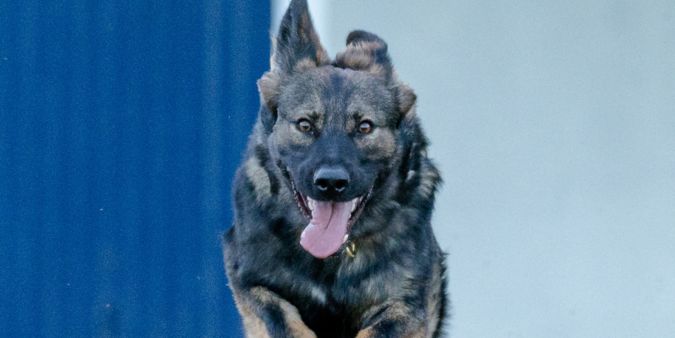
Before They Ever Search: How Search and Rescue Dogs Are Trained
Search and rescue dogs first learn to communicate with their handlers, respond to reliable cues, enjoy working for meaningful rewards and remain confident around unfamiliar sights, sounds and surfaces. These foundations help them work safely and eventually search with greater independence.
A handler calls their dog away from something far more interesting than themselves. The dog turns, runs back and is rewarded with a favourite toy. A few minutes later, they might practise a stay while another dog works nearby, walk calmly on lead through a distracting environment, or simply settle and wait.
None of it looks much like search and rescue. There is no missing person, no search area and, at this stage, no searching at all. Yet this is where the foundations of a search dog are being laid.
Before a K9SAR dog can learn to search independently, it needs a reliable way of communicating with its handler, confidence in unfamiliar environments and, perhaps most importantly, a genuine enthusiasm for working. Developing those things takes time, repetition and a great deal of attention to the individual dog.
Learning a Shared Language
Sit. Down. Stay. Recall. Walking under control on a lead. To most dog owners, these are familiar parts of basic obedience, but for a working dog they eventually become much more than good manners.
A reliable recall, for example, gives a handler a way to bring a dog back when circumstances change. A stay allows the dog to remain safely in one place while something else is happening. Controlled lead walking makes it possible for dog and handler to move together without wasting energy or creating unnecessary tension before the work has even begun.
What matters is not producing a dog that performs a perfectly polished obedience routine. The purpose is communication. The dog needs to understand what the handler is asking and the handler needs to learn how the dog responds when it understands, when it is distracted and, just as importantly, when it is confused.
That makes training a two-way education. Handlers gradually become better at noticing the small things: whether they have increased the difficulty too quickly, whether a distraction is overwhelming the dog, whether the reward being offered is actually rewarding, or whether the dog simply needs the exercise broken down into smaller steps towards the end goal. Sometimes progress means making an exercise harder. Sometimes good training means recognising that today is not the day to do that.
Finding What Makes a Dog Want to Work
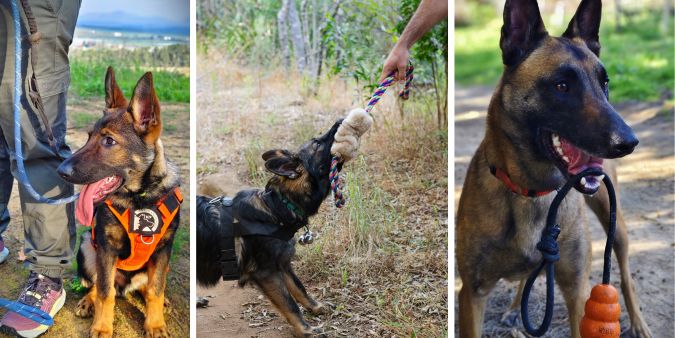
Anyone who has lived with more than one dog will know that what one considers irresistible can leave another completely unmoved. The same is true in training. One dog might do almost anything for food. Another would abandon the finest treat available for the chance to grab a favourite toy. For some, a game or interaction with their handler is particularly valuable, while others eventually find the work itself deeply rewarding.
Finding that individual “currency” is an important part of the process.
Behind it is a straightforward learning principle called operant conditioning. Put simply, when a behaviour produces a consequence the dog values, that behaviour is more likely to happen again. A dog returns when called and discovers that coming back leads to a fantastic game. With repetition, returning to the handler becomes something the dog finds exciting.
The principle may be simple, but applying it well requires the handler to pay attention. A reward only works if the dog actually values it and that can vary not only between dogs but according to the environment and what else is competing for their attention.
This is one reason training should be enjoyable. The aim is not simply to get through a list of exercises, but to build a dog that approaches learning enthusiastically and wants to engage with the problem in front of it. That enthusiasm to work becomes increasingly important as training progresses.
Confidence Beyond the Training Field
A search dog cannot choose where it will eventually be needed, so part of its early education involves learning that unfamiliarity does not necessarily mean worrying.
That might mean encountering unusual surfaces underfoot, unfamiliar noises and smells, different people and animals, or environments that feel very different from home. Exposure is introduced positively and progressively, allowing the dog to investigate and learn without simply overwhelming it with as many new experiences as possible.
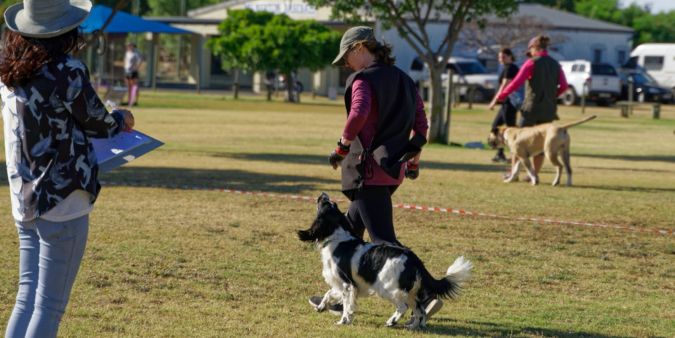
Socialisation plays an important role here too, although perhaps not in the way the word is sometimes understood. A well-socialised working dog does not need to greet every dog or person it sees. Often, the more valuable skill is neutrality: noticing what is happening around it without feeling that it has to become involved.
A dog that can remain comfortable and focused while people move nearby, another dog is working or an unfamiliar sound occurs has begun to develop something extremely useful. The world can carry on around it while it concentrates on the task at hand.
Confidence cannot be rushed, however. If a young or inexperienced dog struggles when the difficulty increases, the answer is not necessarily to push harder. A handler might simplify the exercise, reduce the distraction or return to something the dog already understands before trying again. Training is rarely a perfectly straight line from easy to difficult. Dogs have good days, distracted days and days when something that was simple last week suddenly seems surprisingly complicated. Protecting the dog’s confidence and enthusiasm matters more than advancing according to an arbitrary timetable.
The Useful Contradiction
All of this creates an interesting challenge. Search dogs need excellent communication with their handlers, but ultimately they must also be prepared to work away from them. Too little control would make working safely and effectively difficult. Too much dependence on the handler could create a different problem: a dog that constantly looks back for instructions when it should be using its own abilities to solve the search.
The early obedience work therefore has to achieve something more subtle than compliance. It establishes a shared language without removing initiative.
As training develops, the handler will increasingly need to trust the dog in front of them. That relationship begins with very ordinary exercises: returning when called, waiting when asked, navigating something unfamiliar, ignoring a distraction and discovering that working with this person is rewarding.
Then, eventually, something changes. Someone holds the dog. Its handler runs away. The dog watches as the person it has spent all this time learning to work with disappears and hides. For a moment, all those familiar foundations are still there: the relationship, the motivation, the confidence and the desire to engage.
Then the dog is released to go and find them. And their first search begins.
You will find the article in the October 2026 Magazine. READ IT HERE
DISCLAIMER: The welfare of working dogs varies between organisations and deployments. If you are interested in supporting search and rescue dog welfare in South Africa, visit k9sara.co.za for more information on how operational teams are managed.

The K9 Search and Rescue Association of South Africa (K9SARA-SA) was founded in December 1998 when a few members of the Mountain Club’s Wilderness Search and Rescue team, who saw search dogs in operation, realized that dogs are a valuable resource on any search. It was felt that if we could have a trained team of search dogs ready to go at a moment’s notice, it could cut down on the time needed to find a missing person.