
Disclaimer: This article is intended for general pet-health education and does not replace individual veterinary advice. Gastric dilatation-volvulus is a veterinary emergency. If you suspect your dog may have GDV, seek veterinary assistance immediately.
Bloat, or gastric dilatation-volvulus (GDV), is a rapidly progressing and potentially life-threatening condition in dogs. Large, deep-chested dogs are at greatest risk, but GDV can occur in smaller dogs too. Genetics, body shape, age, meal size and feeding habits may all play a role.
And here’s something many dog parents don’t think about:
It may not only be what your dog eats that matters.
How your dog eats deserves attention too.
If your dog inhales dinner within seconds, would feeding more slowly make a difference? Can a slow feeder help? Does feeding raw food affect bloat risk? And is bloat something small-dog parents need to worry about?
Let’s look at what the research actually tells us.
What is bloat?
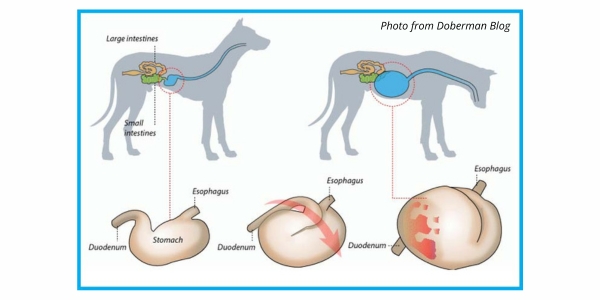
The term “bloat” is commonly used when talking about gastric dilatation-volvulus (GDV), although gastric dilatation and GDV are not exactly the same thing. Gastric dilatation occurs when the stomach becomes distended with gas, food and/or fluid. In GDV, the distended stomach also rotates or twists. That rotation can trap the stomach contents, compromise blood flow, interfere with blood returning to the heart and affect breathing as the enlarged stomach presses against the diaphragm.
GDV can rapidly progress to shock and organ damage.
It is a veterinary emergency requiring immediate treatment.
The American College of Veterinary Surgeons (ACVS) describes GDV as a rapidly progressive, life-threatening condition requiring immediate medical attention.[1]
What are the warning signs of bloat or GDV in dogs?
Repeated, unsuccessful attempts to vomit or retch are one of the classic warning signs of GDV. A swollen abdomen, excessive drooling, restlessness, breathing changes, weakness and collapse can also occur.
Signs can include:
- Repeated retching or attempting to vomit without producing anything
- A swollen or distended abdomen
- Restlessness or obvious discomfort
- Excessive drooling
- Looking at or guarding the abdomen
- Rapid or difficult breathing
- Pale gums
- Weakness
- Collapse
Not every dog will display every symptom.
What should you do if you suspect your dog has bloat?
GO TO THE VETERINARIAN IMMEDIATELY!
Do not wait to see whether the symptoms settle and don’t attempt to treat suspected GDV at home. The longer the stomach remains twisted and circulation is compromised, the greater the potential for serious complications.
Which dogs are most at risk of bloat?
GDV occurs predominantly in large and giant, deep-chested dogs, but breed size alone doesn’t determine risk.
Research has identified several factors associated with increased GDV risk, including:
- Deep, narrow chest conformation
- Large or giant breed
- Increasing age
- Having a first-degree relative that has experienced GDV
- Feeding one large meal per day
- Large meal volume
- Stress or certain behavioural characteristics have been associated with GDV in some studies, although findings are not consistent
- Rapid eating in some studies
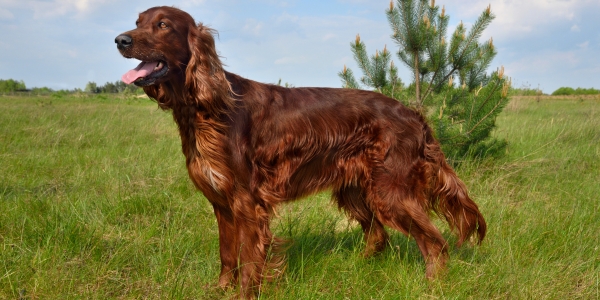
Commonly recognised higher-risk breeds include Great Danes, German Shepherd Dogs, Irish Setters, Gordon Setters, Weimaraners, Saint Bernards and Standard Poodles. Interestingly, Basset Hounds are also listed among predisposed breeds, illustrating why body conformation can matter in addition to overall size.[2]
Genetics are particularly important. Having a parent, sibling or offspring that has experienced GDV has been associated with increased risk.[2][3]
Can small dogs get bloat?
Yes. Small dogs can develop gastric dilatation-volvulus, although GDV occurs much more commonly in large and giant deep-chested breeds.
This distinction matters.
It’s easy to simplify bloat risk as:
Large dog = at risk
Small dog = safe
But that’s not quite accurate. The American College of Veterinary Surgeons notes that gastric dilatation, with or without volvulus, has been reported in nearly all dog breeds.[1]
A 2025 study examining 130 surgically treated GDV cases also illustrates that GDV isn’t exclusively a giant-breed condition. Although large breeds predominated, smaller dogs were represented among the cases.[4]
This type of hospital-based case study doesn’t tell us how common GDV is within different breed sizes, but it does reinforce an important point: smaller dogs should not be considered completely immune to the condition.
So, while the owner of a Great Dane has considerably more reason to discuss GDV risk with their veterinarian than the average owner of a small companion breed, small-dog parents shouldn’t assume GDV is impossible. Regardless of breed or body size, symptoms consistent with GDV warrant immediate veterinary attention.
Does eating too quickly cause bloat in dogs?
Eating quickly has been associated with increased GDV risk in some studies, but the scientific evidence is mixed. We cannot currently say that fast eating directly causes GDV.
This is where responsible interpretation of the research becomes important.
A prospective study involving 1,637 large and giant-breed dogs found that faster eating speed was among the factors significantly associated with increased GDV risk.[3] An earlier case-control study also identified rapid eating among factors associated with increased risk.[5]
However, when researchers subsequently reviewed the available evidence specifically asking whether dogs that eat quickly are more likely to develop gastric dilatation or GDV, they concluded that the evidence was mixed and variable in quality. Where a significant relationship was found, fast eating was associated with increased risk, but other studies found no effect. Importantly, slower eating was not found to increase GDV risk.[6]
So we should not make the claim: “Eating quickly causes bloat.”
Nor should we claim: “Slow feeders prevent bloat.”
A more accurate conclusion is:
Slowing down a dog that habitually gulps food may address one potentially relevant feeding behaviour, but it cannot guarantee prevention of GDV.
Does meal size affect the risk of bloat?
Research suggests that feeding a large volume of food at one meal is associated with increased GDV risk, particularly in susceptible large and giant-breed dogs.
A five-year prospective study involving 1,634 dogs investigated diet-related GDV risk factors.
Dogs consuming a larger volume of food per meal had a significantly increased risk of GDV regardless of how many meals they received each day. Risk was highest among large and giant-breed dogs receiving a large volume of food once daily.[7]
This supports a feeding-management principle frequently recommended for higher-risk dogs:
Consider multiple appropriately portioned meals rather than one very large daily meal.
Your dog’s individual dietary requirements should, of course, determine the total amount of food consumed each day.
Can a slow feeder prevent bloat in dogs?
No. There is currently not enough evidence to claim that slow feeders prevent GDV.
This is an important distinction.
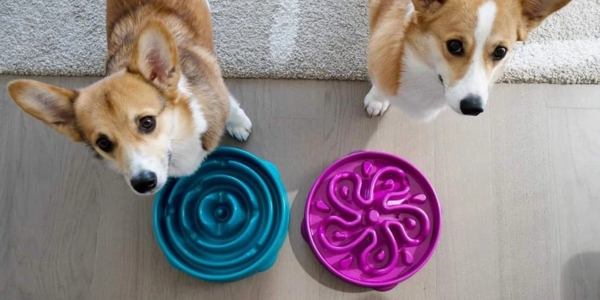
A slow feeder changes how food is presented and consumed. Depending on its design, it may require a dog to lick, navigate grooves or obstacles, or take smaller amounts of food at a time. For the enthusiastic eater whose entire dinner disappears almost instantly, that can turn a very short meal into a slower feeding experience.
Since rapid eating has been identified as a potential risk factor in some GDV research, but not consistently across all studies, slow feeding is best viewed as a feeding-management strategy rather than a GDV preventative treatment.
In other words:
A slow feeder isn’t a medical device and cannot guarantee that your dog won’t develop bloat.
But if your dog habitually inhales food, encouraging slower eating may still be a sensible part of managing mealtime.
Can you put raw dog food in a slow feeder?
Yes. Many slow feeders can be used with raw food, provided the feeder is suitable for wet or raw foods and can be thoroughly cleaned after every meal.
Slow feeders are often pictured filled with dry pellets, which can create the impression that they’re only useful for kibble-fed dogs. They’re not.
For a raw-fed dog, instead of placing the entire meal in one mound in the centre of a conventional bowl, the food can be distributed across an appropriate slow-feeding surface. This encourages the dog to work across the feeder rather than simply taking several very large mouthfuls. Depending on the feeder design and the dog’s individual feeding style, it can also turn dinner into a more engaging activity.
How to use a slow feeder with raw food
Try:
- Spreading minced raw food into the grooves of the feeder
- Dividing the meal between different sections
- Pressing softer ingredients lightly across the feeding surface
- Allowing your dog to lick and work across the feeder rather than serving the meal in one mound
- Choosing a design appropriate for your dog’s muzzle size and feeding style
Always wash and sanitise feeding equipment appropriately after contact with raw meat, following the manufacturer’s care instructions.
And remember: slower isn’t automatically better if your dog becomes frustrated, stressed or starts biting or chewing the feeder.
Choose the feeding method that suits the individual dog.
Does feeding raw food prevent bloat?
There is currently insufficient scientific evidence to claim that feeding a raw diet prevents GDV.
This is another area where correlation and causation can easily become confused.
Research into diet type and GDV has produced inconsistent findings.
A Veterinary Evidence review examining whether kibble-fed dogs were more likely to experience GDV than dogs receiving alternative diets found conflicting results. One study associated small food particle size, largely involving dry-fed dogs, with greater risk, while another found no significant effect from kibble once other risk factors were controlled. The review concluded that there was insufficient quality evidence to establish kibble feeding itself as a GDV risk factor.[8]
More recent evidence also supports caution around attributing GDV risk to a particular type of diet. A large Dog Aging Project study published online in 2025, using data from more than 47,000 enrolled dogs, found that primary diet type was not associated with GDV in the population studied.[10]
This doesn’t mean that all diets are equal in every aspect of canine health. It means that, based on the evidence currently available, we cannot claim that a particular primary diet type prevents GDV.
That also means we cannot reverse the argument and claim that raw feeding prevents GDV.
Raw feeding and slow feeding should therefore be considered separate issues.
If you choose to feed raw, a suitable slow feeder may simply provide a practical way of changing how quickly and how your dog consumes that meal.
Raw feeding and slow feeding should therefore be considered separate issues.
If you choose to feed raw, a suitable slow feeder may simply provide a practical way of changing how quickly and how your dog consumes that meal.
Should dogs eat from raised bowls to prevent bloat?
Current evidence does not support raising a dog’s food bowl as a method of preventing GDV.
This is worth highlighting because raised bowls were historically recommended to some owners of large dogs. In a prospective study of large and giant-breed dogs, feeding from an elevated bowl was associated with an increased risk of GDV rather than a reduced risk.[3] Current Merck Veterinary Manual recommendations for owners of higher-risk dogs include avoiding elevated feeding bowls.[2]
There may be other medical or mobility reasons why an individual dog needs an elevated feeding position. If your veterinarian has recommended one for your dog, follow their individual advice.
But don’t elevate a bowl specifically because you’ve heard that doing so prevents bloat.
What about exercise before or after meals?
You’ve probably heard the advice: “Never exercise your dog after eating because it causes bloat.”
The relationship isn’t quite that simple.
GDV is multifactorial and research hasn’t established exercise around meals as a single direct cause.
Nevertheless, current veterinary guidance for higher-risk dogs commonly includes avoiding vigorous exercise around meals as one part of broader risk management, alongside feeding appropriately sized meals and reducing mealtime stress.[2]
This should be viewed as a precautionary management strategy rather than evidence that exercise after eating directly causes GDV.
For dogs with known GDV risk factors, discuss your dog’s feeding and exercise routine with your veterinarian rather than relying on a universal rule.
How can I reduce my dog's risk of GDV?
There is no feeding method that can guarantee prevention of GDV. Risk management should consider your dog’s genetics, body conformation, age, feeding habits and individual veterinary history.
Practical discussions with your veterinarian may include:
- Know your dog’s risk.
Large, giant and deep-chested breeds deserve particular attention. - Know the family history.
A first-degree relative with GDV increases concern. - Avoid routinely feeding one enormous meal.
Multiple appropriately portioned meals may be preferable for susceptible dogs. - Pay attention to eating behaviour.
If your dog gulps food, consider ways of slowing the meal without causing frustration or stress. - Don’t automatically raise the food bowl to prevent GDV.
Evidence does not support this old recommendation. - Reduce unnecessary mealtime stress.
Dogs competing for food may need to be fed separately. - Know the warning signs.
Early recognition can be lifesaving.
Discuss preventative gastropexy if your dog is high-risk.
What is preventative gastropexy?
A prophylactic gastropexy is a surgical procedure that attaches the stomach to the abdominal wall to help prevent the stomach from twisting. It is often considered for dogs at high risk of GDV.
Importantly, gastropexy doesn’t necessarily prevent the stomach from becoming distended. Its purpose is to help prevent the volvulus, the life-threatening twisting of the stomach.
The American College of Veterinary Surgeons recommends discussing prophylactic gastropexy for dogs at increased risk, including certain large or giant breeds, deep-chested dogs and dogs with close relatives that have experienced GDV.[9]
For some dogs, the procedure can be performed at the same time as sterilisation.
Your veterinarian can help determine whether gastropexy is appropriate for your individual dog.
Sponsored partner: McMac
For dogs that make dinner disappear at impressive speed, changing the feeding surface can be a practical way to make mealtime last longer.
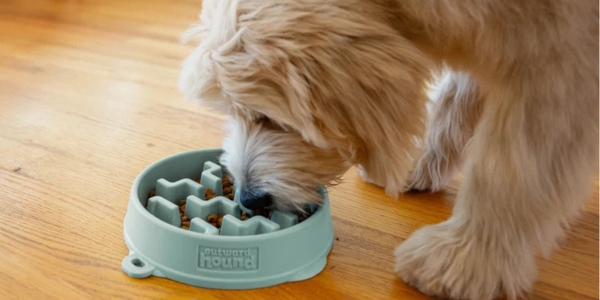
McMac’s slow-feeding products aren’t limited to dry food. Raw food can be spread across a suitable slow feeder, encouraging the dog to lick and work across the feeding surface rather than simply gulping a mound of food from a conventional bowl.
It also adds another dimension to the dog’s daily feeding experience:
Same meal. Different way of eating it.
A slow feeder should always be chosen according to the individual dog’s size, muzzle shape and feeding behaviour and supervised initially to ensure the dog uses it safely.
Explore McMac’s slow-feeding and enrichment products at mcmac.co.za.
McMac is a long-term advertising partner of We Love Pets SA.
When we talk about nutrition, we’re understandably focused on what goes into our dog’s bowl. But how that meal is served deserves attention too. Large meals, genetics, age, body conformation and certain feeding behaviours have all been investigated in relation to GDV.
That doesn’t mean one bowl, one food or one feeding method can prevent bloat. Instead, think about the whole dog.
Know their individual risk.
Feed appropriately sized meals.
Pay attention to how they eat.
Know the warning signs.
And if your dog is considered high-risk, have the gastropexy conversation with your veterinarian.
Because when it comes to GDV, good information and knowing when something is an emergency, matters far more than any single feeding hack.
Frequently Asked Questions
Q: Can any dog get bloat?
A: Yes. Bloat in dogs, or GDV, predominantly affects large and giant deep-chested breeds, but it has been reported across many breeds. Smaller dogs should not be considered completely immune, even though their overall risk is much lower than that of large, deep-chested dogs.
Q: What breeds are most prone to GDV?
A: Higher-risk breeds include Great Danes, German Shepherd Dogs, Weimaraners, Saint Bernards, Irish and Gordon Setters and Standard Poodles. Deep, narrow chest conformation and a family history of GDV are particularly relevant risk factors, regardless of exact breed.
Q: Does eating too fast cause bloat in dogs?
A: The research is mixed. Some studies have associated faster eating with increased GDV risk, while others found no significant effect. Fast eating is best considered a possible contributing factor rather than a proven direct cause of bloat.
Q: Do slow feeders prevent bloat?
A: No. There isn’t enough evidence to claim a slow feeder prevents GDV. It can, however, help change the feeding behaviour of dogs that habitually gulp their meals, which may be a useful part of overall feeding management.
Q: Should I raise my dog’s food bowl to prevent bloat?
A: No. Current evidence doesn’t support elevated feeding as a way to prevent bloat in dogs. In fact, research involving large and giant breeds has linked raised bowls to increased GDV risk rather than reduced risk.
Disclaimer: This article is intended for general pet-health education and does not replace individual veterinary advice. Gastric dilatation-volvulus is a veterinary emergency. If you suspect your dog may have GDV, seek veterinary assistance immediately.
REFERENCES:
- American College of Veterinary Surgeons (ACVS). Gastric Dilatation-Volvulus.
https://www.acvs.org/small-animal/gastric-dilatation-volvulus/ - Merck Veterinary Manual. Gibson TWG. Gastric Dilation and Volvulus in Small Animals. Reviewed/updated August 2025.
https://www.merckvetmanual.com/digestive-system/surgical-problems-of-the-gastrointestinal-tract-in-small-animals/gastric-dilation-and-volvulus-in-small-animals - Glickman LT, Glickman NW, Schellenberg DB, Raghavan M, Lee T. Non-dietary risk factors for gastric dilatation-volvulus in large and giant breed dogs. Journal of the American Veterinary Medical Association. 2000;217(10):1492–1499. PMID: 11128539.
- Olimpo M, Cillari S, Ferraris EI, et al. Gastric Dilatation-Volvulus in Dogs: Analysis of 130 Cases in a Single Institution. Animals. 2025;15(4):579. doi:10.3390/ani15040579.
- Glickman LT, Glickman NW, Schellenberg DB, Simpson K, Lantz GC. Multiple risk factors for the gastric dilatation-volvulus syndrome in dogs: a practitioner/owner case-control study. Journal of the American Animal Hospital Association. 1997;33(3):197–204. PMID: 9138229.
- Buckley LA. Are Dogs That Eat Quickly More Likely to Develop a Gastric Dilatation (+/- Volvulus) Than Dogs That Eat Slowly? Veterinary Evidence. 2016;1(4). doi:10.18849/ve.v1i4.53.
- Raghavan M, Glickman N, McCabe G, Lantz G, Glickman LT. Diet-related risk factors for gastric dilatation-volvulus in dogs of high-risk breeds. Journal of the American Animal Hospital Association. 2004;40(3):192–203. doi:10.5326/0400192. PMID:15131099.
- Buckley LA. Are Dogs Fed a Kibble-Based Diet More Likely to Experience an Episode of Gastric Dilatation Volvulus Than Dogs Fed an Alternative Diet? Veterinary Evidence. 2017;2(2). doi:10.18849/ve.v2i2.63.
- American College of Veterinary Surgeons (ACVS). Prophylactic Gastropexy.
https://www.acvs.org/small-animal/prophylactic-gastropexy/ - 10. McCord MA, O’Brien J, Ryave J, et al. Gastric dilatation-volvulus is associated with Poodle breeds, increased body size, and male sex, but not primary diet type or anxiety in the Dog Aging Project cohort. Journal of the American Veterinary Medical Association. Published online December 2025. doi:10.2460/javma.25.09.0609.
McMac is a premium pet brands distributor, importer and supplier, bringing trusted pet products to stores across South Africa. From slow feeders to enrichment essentials, McMac partners with well-loved international brands to help South African pet parents access quality products for their dogs and cats. Find their range at mcmac.co.za.
McMac is a long-term advertising partner of We Love Pets SA.