

DISCLAIMER: This article is intended for educational purposes only and does not constitute veterinary advice. If you are concerned about your dog’s health, please consult a registered veterinarian. In an emergency, contact your nearest veterinary clinic immediately.
What is IVDD and why should every dog owner know about it?
IVDD in dogs (Intervertebral Disc Disease) is one of the leading causes of sudden spinal paralysis in dogs and it can escalate from mild back pain to complete loss of mobility in as little as 24 to 48 hours. It affects certain breeds more than others, but any dog can develop it. Knowing the early warning signs and acting quickly is the single most important thing you can do for your dog’s recovery.
Back pain in dogs is often dismissed as stiffness or ageing, but in some cases, it can signal a far more serious condition. Intervertebral Disc Disease (IVDD) is one of the leading causes of sudden paralysis in dogs and early recognition can significantly improve outcomes.
What is IVDD?
Intervertebral Disc Disease (IVDD) occurs when the cushioning discs between the vertebrae of the spine degenerate, bulge or rupture.
This places pressure on the spinal cord, interfering with nerve signals. The result can range from mild discomfort to complete loss of mobility.
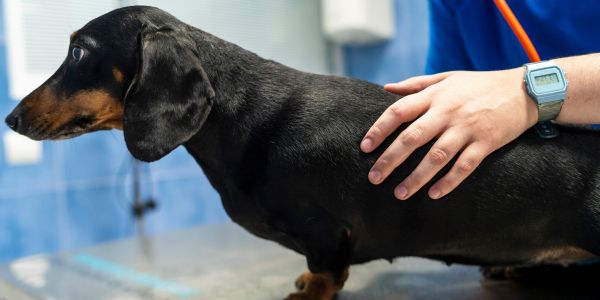
Why IVDD Matters: What the research shows
- Studies estimate that about 1 out of 4 Dachshunds will develop IVDD during their lifetime.
- IVDD is one of the most common neurological conditions seen in small breed dogs.
- In severe cases, dogs can progress from mild pain to paralysis within 24–48 hours.
- Outcomes are significantly better when treatment is initiated early, especially before loss of deep pain sensation.
These statistics highlight just how quickly this condition can escalate and why early action is critical.
Which dogs are most at risk?
IVDD is most commonly seen in chondrodystrophic breeds with long backs and shorter legs, including:
- Dachshunds
- French Bulldogs
- Beagles
- Pekingese
- Corgis
- Basset Hounds
That said, any dog (regardless of breed) can develop IVDD.
Early signs to watch for
The early stages are often subtle and easy to overlook:
- Reluctance to jump or climb stairs
- Stiffness or reduced mobility
- Neck or back pain
- Shaking or trembling
- A hunched posture
- Decreased activity levels
Often, owners describe their pet as “just not quite right.”
When it becomes urgent
As pressure on the spinal cord increases, symptoms can escalate rapidly:
- Weakness in the hind legs
- Difficulty walking or standing
- Dragging of the back legs
- Loss of coordination
- Loss of bladder or bowel control
- Paralysis
These signs require immediate veterinary attention.

What should you do if you suspect IVDD
Time plays a critical role in recovery. If you notice concerning signs:
- Strictly restrict movement immediately
- Keep your dog calm and confined
- Avoid stairs, jumping or walking
- Seek veterinary care without delay
Delaying intervention can reduce the chances of recovery.
How is IVDD treated?
Treatment depends on severity and timing of intervention:
- Mild cases: Strict rest and anti-inflammatory medication
- Moderate cases: Pain management and structured rehabilitation
- Severe cases: Surgical decompression of the spinal cord
Dogs treated early (before severe neurological deficits) have significantly better outcomes.
Can IVDD be prevented?
While IVDD cannot always be prevented, risk can be reduced:
- Maintain a healthy body weight
- Limit high-impact activities
- Use ramps instead of stairs or jumping
- Support the spine when lifting your dog
- Be proactive with at-risk breeds
When to see your vet
Seek veterinary care if your dog:
- Shows any signs of spinal pain
- Becomes reluctant to move or jump
- Develops weakness or coordination issues
Do not wait for symptoms to worsen. Early assessment is essential.
IVDD is a serious condition, but with early detection and appropriate management, many dogs recover well. The key is recognising the early warning signs and acting quickly.
If you are concerned about your dog’s mobility or spinal health, book a consultation with your vet. Early diagnosis can make a life-changing difference.
You will find the article in the June 2026 Magazine. READ IT HERE.
DISCLAIMER: This article is intended for educational purposes only and does not constitute veterinary advice. If you are concerned about your dog’s health, please consult a registered veterinarian. In an emergency, contact your nearest veterinary clinic immediately.

FAQ Section
Q: What are the first signs of IVDD in dogs?
A: The earliest signs of IVDD in dogs are often subtle. Reluctance to jump or climb stairs, a hunched posture, neck or back pain, shaking or trembling and decreased activity. Owners frequently describe their dog as just “not quite right.” These signs should never be dismissed, as IVDD can escalate quickly without treatment.
Q: Can a dog recover from IVDD without surgery?
A: Yes, many dogs with mild to moderate IVDD recover without surgery through strict rest and anti-inflammatory medication. However, severe cases, where there is significant spinal cord compression or loss of deep pain sensation, often require surgical decompression for the best chance of recovery. Early veterinary assessment is essential to determine the right treatment.
Q: How quickly can IVDD cause paralysis in dogs?
A: In severe cases, IVDD in dogs can progress from mild pain or stiffness to complete hind-leg paralysis within 24 to 48 hours. This is why acting at the very first sign of spinal pain is so important. Delaying veterinary care, even by a day, can significantly reduce the chances of a full recovery.
Q: Which dog breeds are most likely to get IVDD?
A: Breeds most commonly affected include Dachshunds, French Bulldogs, Beagles, Corgis, Pekingese and Basset Hounds. These are chondrodystrophic breeds. They have long backs relative to their leg length, which places greater stress on spinal discs. Research suggests approximately one in four Dachshunds will develop IVDD during their lifetime. That said, any dog can be affected regardless of breed.
Q: What should I do immediately if I think my dog has IVDD?
A: If you suspect IVDD, restrict your dog’s movement immediately. No stairs, jumping or unsupported walking. Keep them calm and confined and get to a vet as soon as possible. Do not wait to see if symptoms improve on their own. Time is critical with IVDD: the sooner treatment begins, the better the outcome is likely to be.
Dr Falon Olfsen, Value Vet in Hazelwood

Dr. Falon Olfsen, the Founder and Head Veterinarian at Value Vets, brings over a decade of experience in small animal care. She is highly regarded for her gentle approach and unwavering dedication to patient care. Dr. Olfsen’s expertise extends across a range of special interests, including nutrition, animal behaviour and geriatric care, making her a compassionate advocate for pets at every stage of life. Her deep commitment to the well-being of animals has earned her the trust and respect of both clients and colleagues.