
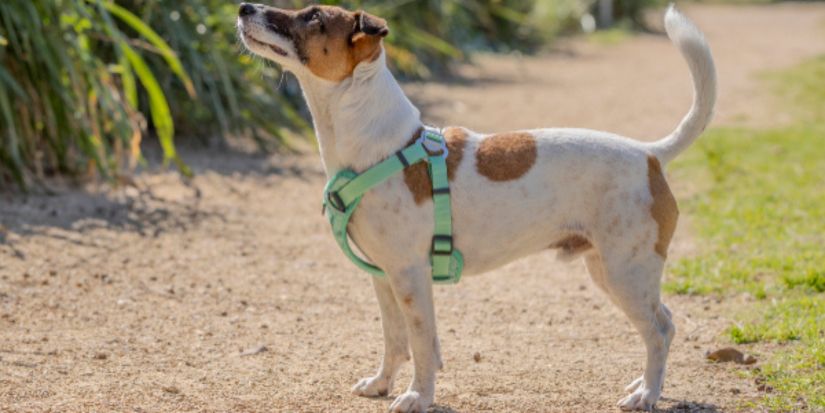
Beyond Obedience: How Leash Pulling Can Affect Your Dog’s Body
We often think of loose-leash walking as a training skill, but repeated pulling also changes how force is transferred through a dog’s body. Equipment and fit matter, but no collar or harness completely removes the effects of constant leash tension. Teaching a dog to walk comfortably on a slack leash can therefore support both everyday handling and physical wellbeing.
When we think about leash training, it’s usually framed around convenience or good manners. We want a dog who doesn’t drag us down the sidewalk, react to passing distractions or pop our shoulder out of its socket.
From a veterinary physiotherapy perspective, loose-leash walking isn’t just a behavioural goal. It is a foundational healthcare skill!
A common misconception among dog owners is that changing equipment (moving from a flat collar to a harness or switching to a front-clip setup) instantly fixes the physical strain of pulling. While the right gear can improve safety and
redistribute pressure, no piece of equipment eliminates the physical toll of continuous tension.
If a dog leans into a leash consistently day after day, that force travels directly into their muscles, joints and spine. Let’s
look at what chronic pulling does to your dog’s body over time.
What happens when a dog pulls against a collar?
Dogs are naturally built to carry roughly 60% of their body weight on their front limbs and 40% on their hind limbs. In a normal, fluid gait, power is generated in the hindquarters, travels through the spine and is absorbed smoothly by the
front legs.
When a dog pulls continuously on a leash, this natural balance breaks down. To fight against leash tension, the dog must throw their center of gravity drastically forward. This forces the front legs to act as heavy traction anchors
rather than shock absorbers, while the hind legs disengage; leading to unbalanced muscle development and
abnormal biomechanics.
How this compensatory posture damages the body depends directly on where the leash tension is anchored:
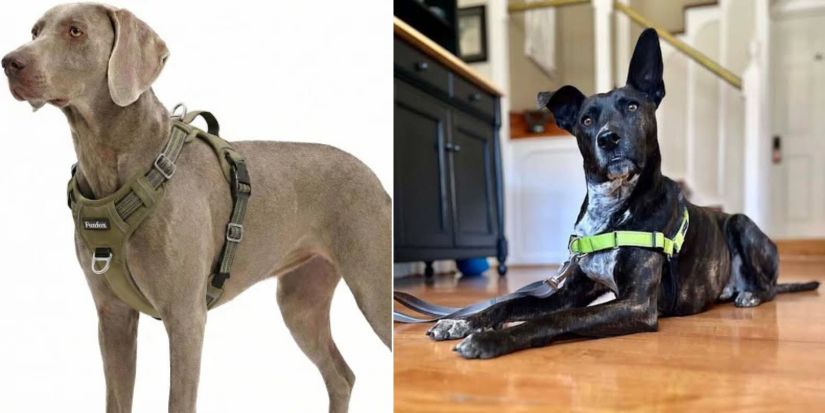
FLAT COLLARS
When a dog pulls on a collar, high focal force is concentrated directly onto the soft tissue around the front of the throat and delicate cervical vertebrae. To brace against this pressure, the dog must alter the position of the neck, keep muscles of the neck engaged abnormally and alter their breathing. Over time, this constant trauma increases the risk of tracheal
compression, thyroid damage, joint stress and elevated pressure in the eyes.
RESTRICTIVE STEP IN AND “NO-PULL” HARNESSES
Harnesses with a horizontal strap across the chest create a physical barrier over the shoulder joints. To pull forward, the dog is forced into a short, choppy stride. This restricts normal shoulder blade rotation, strains surrounding tendons and alters forelimb mechanics across the entire front assembly. Some harnesses in this style may also place a focal pressure
point onto the front point of the sternum (the manubrium) or even the trachea, in which case there would be added stress
similar to the flat collar.
Harnesses with a clip in the front tend to produce an asymmetrical gait as the leash pulls to one side. These harnesses also tend to move or rotate on the dog’s body.
Harnesses which tighten around the forelimb or chest when the dog pulls create movement and tension behind the front limb in the ‘armpit’ region; they restrict shoulder and scapular mobility and often encourage the elbows to be
turned out. These harnesses can also cause discomfort through rashes, chaffing or pinching.
ILL-FITTING BACKCLIP OR Y-SHAPED HARNESSES
If a harness neck opening sits too low, it smothers normal shoulder extension. If the girth strap sits too close behind the front legs, it continuously rubs sensitive armpit tissue, encouraging the dog to walk with their elbows turned outward. This creates abnormal rotational stress through the shoulders, elbows and wrists.
PHYSIO NOTE:
A well-fitted, Y-shaped harness is the safest option for preserving full joint range of motion. However, it is a tool for body protection; not a cure for pulling. If the leash is tight, kinetic stress is still entering your dog’s body.
Regardless of the restraint type, daily posture compensations eventually become your dog’s default way of moving. Just like a human hunched over a desk develops chronic back pain, a pulling dog builds uneven muscle tone and joint stress.
Y-SHAPED HARNESSES
While a well-fitted Y-harness is the ergonomic gold standard for free joint movement, hard pulling still carries physical consequences. The continuous backward force presses heavily against the chest bone and pulls the mid-back into rigid extension or flexion depending on the dog. This is especially true when using a ‘normal length leash’, which would produce a greater angle of force, or an upward direction of force. To brace against this, the deep stabilizing muscles along the spine contract continuously, which could lead to chronic back stiffness and soft-tissue soreness. Depending on the fit of the harness, this type of harness can cause discomfort in the joints of the last 2-3 ribs, or localised
joint pain at the junction between the thoracic and lumbar spine.
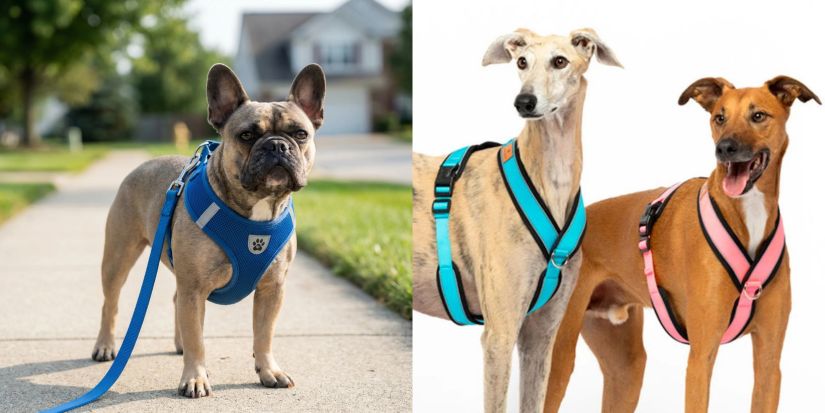
The Exception to the Rule: What About Pulling Sports?
You might be wondering: “If pulling is so bad for a dog, what about canicross runners, bikejoring teams, or sled dogs?”
It’s a fair question!
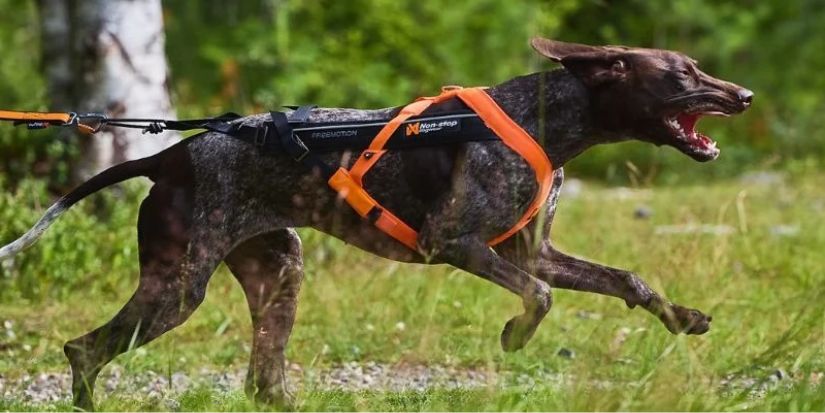
These working dogs pull with immense force, yet they maintain incredible athletic condition without developing the chronic injuries seen in everyday pet dogs. The difference comes down to harness design, force angle and physical preparation.
ERGONOMIC SPORT HARNESSES
Everyday walking harnesses are built for control from above the dog. Specialized pulling harnesses are engineered specifically for draft work:
- Force Distribution: Force is carried along longer continuous lines, allowing for dispersed forces rather than focal points. Resistance is routed straight into the dog’s powerful hindquarters; their natural engine.
- Full Shoulder Clearance: The neck opening rests securely on the chest bone, leaving the shoulders completely free to extend through their full range of motion.
- Low Pull Angle: The tow line stays low behind the dog, allowing the spine to stay in a neutral, natural line rather than being pulled upward or twisted sideways and allowing the dog to continue to recruit their entire body into the force rather than localised areas taking all the stress.
PHYSICAL CONDITIONING & BALANCED TENSION
Unlike a pet dog who may jerk into the leash, stop suddenly, pull skew to sniff, or pull at odd angles, sport dogs pull with
predictable, straight-line tension. Their muscles build balanced strength rather than awkward compensations.
Furthermore, their tendons, ligaments and core muscles are conditioned gradually over months to handle heavy loads safely.
THE TAKEAWAY:
In pulling sports, a conditioned dog uses their back legs to drive forward in a harness built to distribute force across the whole skeleton. On an everyday walk, an unconditioned pulling dog strains from their front legs, twists against a high leash and puts abnormal stress through their joints.
Reframing Loose-Leash Walking as Preventative Care
When we view leash training strictly as an obedience exercise, it’s easy to let consistency slide on days when we’re tired or rushed. But when we look at it through the lens of long-term physical health, the priority becomes clear.
Teaching your dog to walk on a slack line:
- Protects delicate neck structures and spinal alignment.
- Preserves natural, symmetrical shoulder movement.
- Keeps body weight evenly balanced across all four limbs.
- Prevents chronic muscle tightness and abnormal stress and wear on joints.
Investing the time to build a solid loose-leash walk is about giving your dog the gift of pain-free movement for years to come!
Health note: This article provides general educational information and is not a substitute for an individual veterinary or veterinary physiotherapy assessment. Pain, lameness or changes in movement should be assessed by an appropriate veterinary professional.

At Pets in Balance Animal Physiotherapy Centre, our passion is helping pets enjoy healthier, happier lives through improved mobility and pain relief. Our dedicated team takes a holistic approach to patient care, specialising in the rehabilitation of animals recovering from surgery, living with neurological conditions or managing arthritis and other musculoskeletal disorders. Using a variety of physiotherapy techniques and tailored treatment options, we aim to relieve pain, restore movement, improve physical function and support athletic performance.