

Why do healthy dogs need a ramp?
A dog ramp for dogs isn’t just for senior or injured pets, it protects joints from the cumulative strain of everyday jumping, on and off beds, couches and cars, that builds up silently over years. Most pet parents only consider a ramp once their dog is already hesitating, recovering from surgery, or slowing down with age. Introducing one earlier, while your dog is fit and confident, builds a protective habit rather than managing a problem after it’s already started.
How does jumping actually damage a dog's joints over time?
Dogs are more a part of the family than they’ve ever been. Increasingly, they’re not restricted to living outside the way they once were, they’re on the bed, on the couch, in the car for a beach walk or a trail run, full members of the household in a way that’s new for a lot of breeds. It also means jumping on and off hard, high surfaces, several times a day, for years, which is worth paying attention to.
When I built Emmy’s first ramp, I wasn’t thinking about prevention. She’d spent years jumping in and out of the car on the way to and from daycare, off the bed, off the couch, completely normal stuff for a healthy dog, before a cruciate injury needed surgery. The ramp came after that, not before it.
That’s how most people come to ramps.
A vet mentions one after surgery, or a dog gets older and starts hesitating before a jump they used to make without thinking, and someone finally goes looking for a solution. I understand why. Nobody thinks about protecting a joint that isn’t hurting yet.
But years of building ramps and talking to hundreds of dog owners have taught me something: by the time a dog is struggling to jump, the damage that got them there has usually been building for years.
The jump that finally does it isn't the one that started it
Every time a dog jumps down, off a bed, off a couch, out of a car, their front legs absorb a landing force well beyond their own body weight. One jump is nothing. Thousands of jumps, over years, on joints that were never built for repeated impact, is a different story. That’s exactly what happened with Emmy. She jumped in and out of the car, on and off the bed, on and off the couch for years before her knee finally gave out. The jump that tore her cruciate wasn’t the cause. It was the last of thousands that had been.
Emmy didn’t have a diagnosed joint condition or an obvious breed risk. She was just a healthy dog doing something healthy dogs do every day. That’s exactly why this is so easy to miss. Any dog who jumps in and out of a car or on and off furniture, day after day, year after year, is building up the same kind of cumulative strain, whether there’s anything unusual about them or not. Long-backed breeds like dachshunds, corgis and basset hounds do carry extra spinal risk on top of that, and I’d say a ramp is close to essential for them from puppyhood. But this isn’t only a long-backed-breed problem, or an already-injured-dog problem. If your dog does this as part of an ordinary day, it’s worth thinking about.
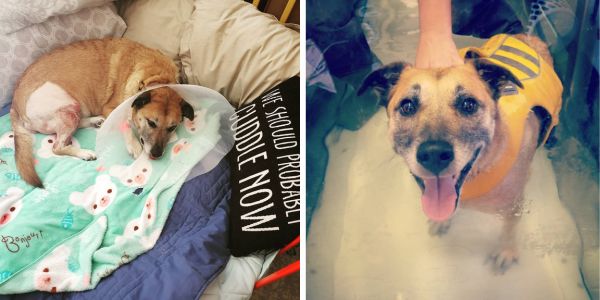
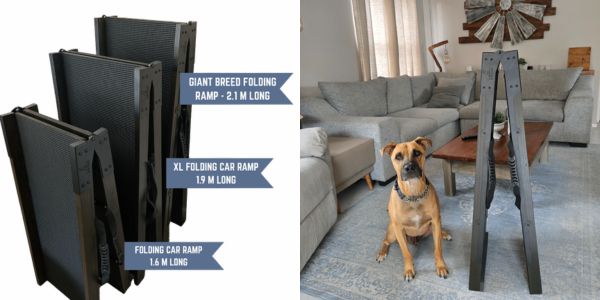
That’s exactly why I started building ramps in the first place. The ramps I could find locally weren’t grippy or stable enough, and most were too short to keep the angle safe, so I built my own instead. I didn’t want other dog owners to go through what Emmy and I went through, and educating people about the dangers of repeated jumping, and what a ramp actually does about it, has become as much a part of what I do as building the ramps themselves.
The healthiest thing you can do is introduce a ramp before your dog needs one. A young, fit dog learns to use a ramp calmly and confidently, without the fear or discomfort that often comes with training an already-injured or elderly dog to use one for the first time. You’re not managing a problem. You’re building a habit that protects them for the next ten or twelve years.
Just as most people only think about a ramp once their dog is already injured or old, most people don’t think about physio while their dog is still young and healthy either. It’s been just as big a part of Emmy’s story as the ramps. There are some amazing veterinary physiotherapists out there, and Emmy and I have had the pleasure of working with a number of them over the years. One of those is Kirsten Straszacker at Startline Veterinary Physiotherapy.
KIRSTEN STRASZACKER, VETERINARY PHYSIOTHERAPIST, STARTLINE VETERINARY PHYSIOTHERAPY
“I’ve been treating Emmy for the past year, largely because of what all those years of jumping eventually did to her joints. Physio like hers, hydrotherapy, targeted strengthening, mobility work, all contribute to rebuilding what repeated impact wears down. It’s a big part of getting a dog back to an active life after an injury. But a strong, well-conditioned dog also has greater capacity to recover when bad landings do eventually happen, making physical wellbeing of the dog worth thinking about before there’s a problem – not just after. A ramp plays a role in greatly reducing the landing impact on a dog’s joints when jumping from high surfaces. Physiotherapy strengthens the components of the body that are left to absorb this landing impact . These two components work together.”
Getting the basics right (grip, angle, length)
If you’re introducing a ramp, a few things matter more than the rest. Give your dog a surface with real grip, wet paws and all, a ramp that feels slippery underfoot won’t get used twice. Keep the angle gentle too, no steeper than 20 to 25 degrees, which comes down to length: the higher the surface, the longer the ramp needs to be to keep that angle manageable. Dog Mom has a free ramp angle calculator online if you want to find out more about safe gradients.
A ramp is always the better option, but if you don’t have the space for one, or a ramp genuinely isn’t possible for another reason, pet steps are better than nothing. Steps still carry some risk of their own, depending on the incline and the height of each step, and that risk is higher for long-backed breeds. But steps beat a straight jump on and off the couch or bed every time.
If your dog jumps in and out of the car, on and off the couch, up onto the bed, every single day, that’s worth a second look, whether anything seems wrong or not. I built my first ramp because Emmy needed it after the fact. I’ve spent the years since trying to help other dog owners get ahead of that moment instead of catching up to it. A healthy dog doesn’t need a ramp because something is wrong. They need one so nothing has to go wrong in the first place.
Sandra Boome
“I handcraft every Dog Mom ramp myself and I’m always happy to help a dog owner work out what will actually suit their dog’s size, age and situation.”
COMMERCIAL DISCLOSURE:This article is for general educational purposes and isn’t a substitute for individual veterinary advice. If your dog is showing signs of joint pain, stiffness or reluctance to jump, please consult your vet or a qualified veterinary physiotherapist. Sandra Boome is the founder of a ramp-making business, Dog Mom. Product mentions in this article are included for educational context only; WLPSA does not sell products or endorse specific brands.

FAQ Section
Q: Do healthy dogs need a ramp?
A: Yes. A dog ramp for healthy dogs helps prevent the cumulative joint strain caused by everyday jumping, off beds, couches or cars, before any injury develops. Waiting until a dog is already hurt or elderly means training them on a ramp while they’re in pain or afraid, which is harder than building the habit early, while they’re fit and confident.
Q: What angle should a dog ramp be?
A: A safe dog ramp angle is no steeper than 20 to 25 degrees. The higher the surface your dog is climbing to, such as a car boot or a bed, the longer the ramp needs to be to keep that angle manageable and comfortable for your dog’s joints.
Q: Can jumping cause a cruciate ligament injury in dogs?
A: Repeated jumping over years can contribute to the cumulative strain that eventually leads to a cruciate ligament injury. The final jump that causes a tear is rarely the true cause; it’s usually the last of thousands of ordinary jumps that gradually wore the joint down.
Q: Which dog breeds are most at risk from jumping injuries?
A: Long-backed breeds such as dachshunds, corgis and basset hounds carry extra spinal risk from jumping, making a ramp especially valuable from puppyhood. However, any dog that jumps on and off furniture or in and out of a car daily is building up cumulative strain, regardless of breed.
Q: Are pet steps as good as a ramp for dogs?
A: A ramp is generally the better option for protecting a dog’s joints, but pet steps are a reasonable alternative if space or another factor rules out a ramp. Steps still carry some risk depending on their incline and height, particularly for long-backed breeds, but they’re safer than a straight jump on or off furniture.
Sandra Boome is the founder of Dog Mom™

Sandra Boome is the founder of Dog Mom™ and the owner-designer behind Boometime Custom Design, a Cape Town-based woodworking studio. Her journey into dog ramps began in 2018, when her dog Emmy needed cruciate ligament surgery on both knees. A borrowed plastic ramp didn’t give Emmy the grip or confidence she needed, so Sandra built one herself. What started as a solution for Emmy became a calling: people kept approaching her outside vet and veterinary physiotherapy practices, asking for ramps of their own. Sandra now handcrafts couch ramps, bed ramps, raised feeders, dog beds and Bailey Chairs, drawing on both her design background and years spent learning, first-hand, what actually protects a dog’s joints. She shares her home with her two furkids, Emmy and Levi.